
What care home managers told us about their daily work
We ran a survey of UK care home managers between September 2025 and January 2026, asking about admin, compliance, family updates and resident risk. Here is what came back, including the parts we did not expect. If you took part, this is the summary we promised you.
Most homes already use digital records
Every manager who answered already uses a DSCR-compliant record system. Almost all use something for the rota as well.
Digital records are already in place. What matters more is the work that still sits outside them. The answers that followed pointed at the same few areas: compliance evidence, family updates, and the parts of the week that are not recorded anywhere.
One manager still keeps paper alongside the digital records. Only a small number have anything that reaches a resident's family.
Care notes take the most staff time
We asked how much staff time each task takes per week. Care planning and daily notes came out highest.
Compliance, audits and inspection preparation came second. It also had the widest spread of answers. Some homes get through it in under an hour. Others spend more than ten. That usually means the work is being done in different ways rather than at different volumes.
The tasks at the bottom of the list are worth noting too. Last-minute cover and billing take up little time each week. That matters later, because time spent and frustration turned out to be different things.
Rota planning was named the most frustrating task
Two thirds of managers named rota and shift planning as frustrating or repetitive. It sits mid-table on time taken.
Last-minute cover is the clearest example. It takes the least time of anything on the list and was one of the three most frustrating. A task that takes twenty minutes can still disrupt an afternoon if it arrives without warning and has to be sorted out by phone.
Medication records were barely mentioned here. That says something good about the systems already handling that work.
Compliance is the one task managers want to keep
We asked two questions separately. Which tasks are frustrating, and which tasks managers would trust a digital tool with. Put the answers on the same map and one task stands apart.
Compliance, audits and inspection preparation was named as frustrating by just over half the group. Almost none of them would trust a tool to handle it. Every other frustrating task on the list is one managers would pass to software.
That comes down to accountability. The registered manager signs off the evidence. Software can gather it, keep it in order and have it ready. The decision about whether it is good enough stays with the manager.
Scroll sideways to see the whole map.
Care documentation is the first thing managers would improve
Care documentation was ranked first by most managers and in the top three by nearly all of them. Billing and invoicing was ranked last by every manager who ranked the list.
Billing being last does not mean managers want to keep doing it. Most said they would trust a tool with it. It is just not where the pressure sits.
Medication management and staff scheduling came second and third. Compliance sits mid-table, which is worth reading next to the previous section. Managers want it improved. They do not want the decisions taken off them.
- Care documentationRanked first by most managers
- Medication managementTop three for over half
- Staff schedulingTop three for two thirds
- Compliance & inspectionsConsistently mid-table
- Family communicationWide spread of opinion
- Resident onboardingRarely urgent
- Staff onboarding & trainingNever placed in the top three
- Billing & invoicingPlaced last by every manager
Two questions everyone answered the same way
Nothing else in the survey produced full agreement.
On confidence in automated risk alerts, with staff always making the final call, most said very confident and the rest said somewhat confident. Nobody said they would not trust it. On timing, two thirds want to be told the day before and again on the day.
Flagging residents at higher risk
Every manager said it would be very useful for a system to highlight residents who may be at higher risk of falls, infections or deterioration, based on their daily records.
Managing resident appointments
Every manager said it would be very useful for the system to hold GP visits, exams and specialist checkups and notify the responsible staff member ahead of time.
Falls, medication errors, wellbeing
All three were selected by every manager as areas they would want early warnings about. Infections and upcoming appointments were named by nearly all.
Staffing and overtime risk
The only alert type that split the group. One manager added choking risk, epilepsy and DNACPR status to the list.
Families do not get regular updates
Two thirds of managers said their current systems give families no regular updates about their relative.
Among managers whose systems do not reach families, all but one said secure updates would be useful.
There is a caveat. Family communication was one of the tasks managers were least willing to automate. Read together, those answers point the same way. Give families a view of the record, and leave the conversations to people.
What managers said they would pay
We asked what monthly cost would feel reasonable for a platform that saved staff hours, reduced errors, improved family communication and gave early warnings about resident risk. Every answer fell between £500 and £2,000 a month.
Just over half chose the £1,000 to £2,000 band. Nobody picked below £500 and nobody picked above £2,000. For a question that usually gives a wide spread, that is a narrow result.
What else takes up time
One open question asked what else takes a lot of time. The answers were the most useful part of the survey.
Booking appointments. Emails. Phone calls. Family consultations and meetings. Managers' meetings. Health and safety tasks. Debriefs after incidents. Medication ordering and checking. Activity planning.Registered manager, mid-sized home
Daily walks around, for the manager and for health and safety.Registered manager, larger home
Some issues relating to software at the beginning of introducing digital tools.Registered manager, smaller home
Two apps, one for managers and one for caregivers
Granily is care management software for UK residential care homes. Managers use a web app for the wider overview of the home. Caregivers use a mobile app during the shift.
Managers, in the web app
A clearer overview of the home
The dashboard shows open alerts, overdue tasks, who is on shift and how many residents have a risk flag. Alerts run on rules an administrator sets in settings. A named person acknowledges or resolves each one, so there is a record of who saw what and when.
Managers use the same app for the rest of the home: residents, staff, rota, medications, incidents, training records and compliance. Shifts are built from templates, generated across a date range and assigned to staff. When someone drops out, a manager raises a cover request against that shift. Rota planning was the task this group named as frustrating more often than any other.
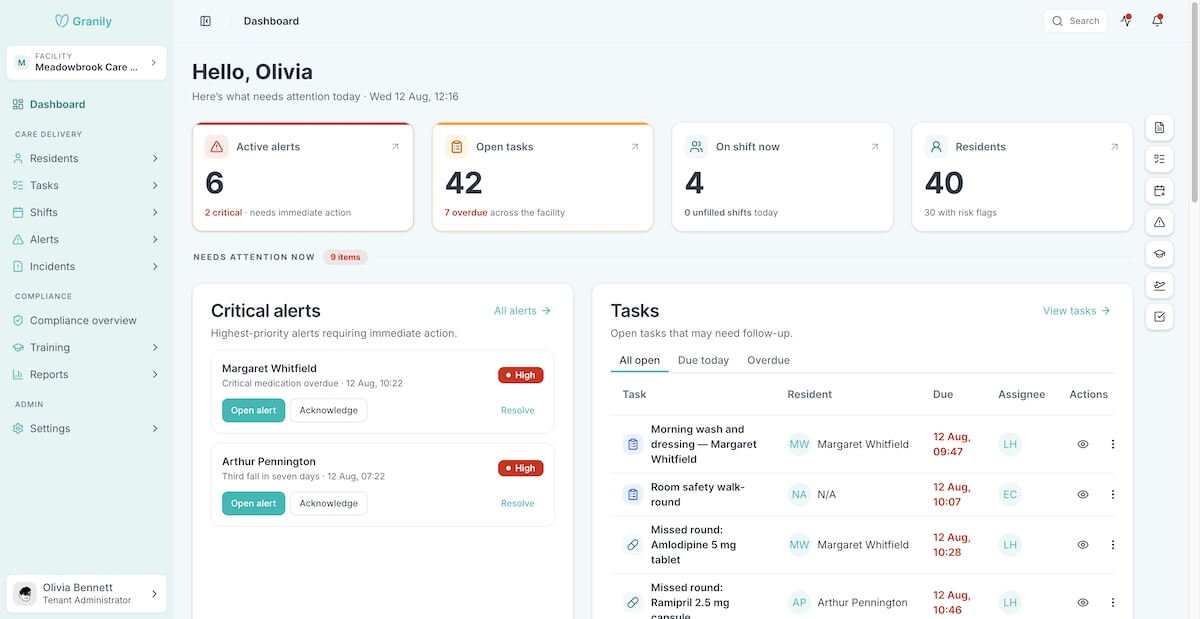
Manager dashboard. Sample data from a demo facility.
Caregivers, on the mobile app
Care notes and medication during the shift
Caregivers use the mobile app during a shift, close to residents, without having to go back to the computer each time. The app shows the shift, the residents assigned and the next task with its time. A medication round is recorded against the task while it happens instead of being written up at the end of the shift.
Below that is a list of residents flagged as higher risk today, with the reason shown, so a caregiver can see who to check on.
A caregiver can correct their own note for a short window after writing it. After that the entry is locked and changes go through a manager. That keeps daily notes usable as evidence later, which matters given how the group answered on compliance.
Skipping a task asks for a coded reason instead of free text, so a skipped round reads the same way in an audit months later as it did on the day.
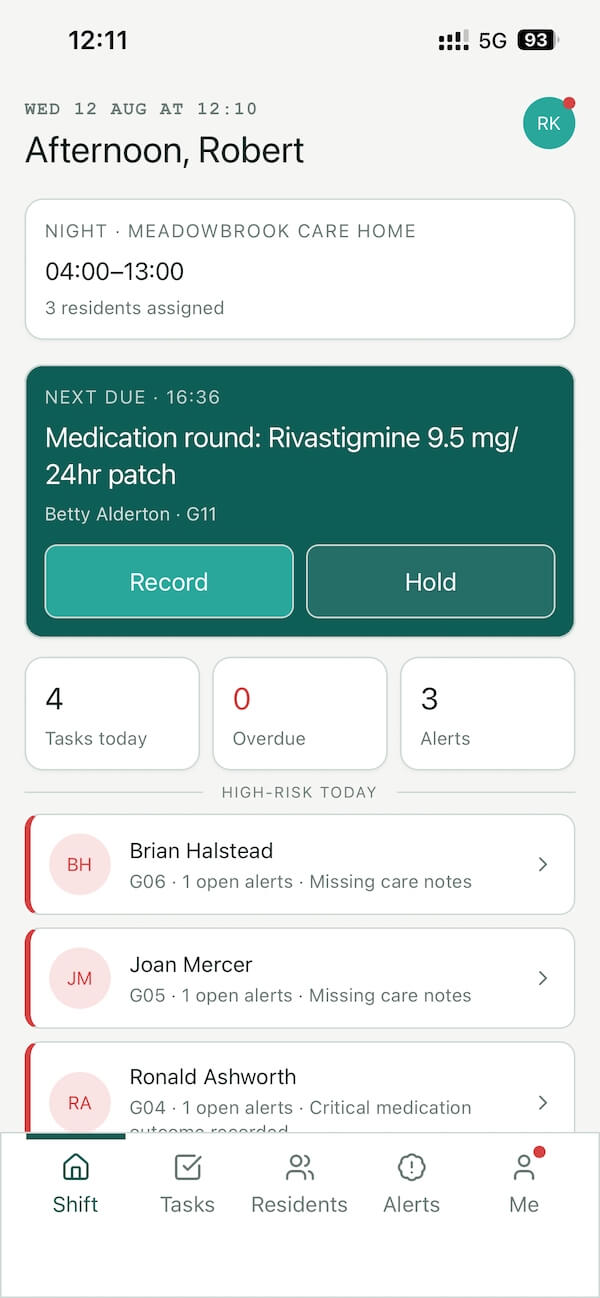
Caregiver mobile app. Sample data from a demo facility.
What we changed, and what is still missing
On the left is what the survey said. On the right is what is in Granily now, including the parts that are not built yet.
Care documentation came firstRanked top for improvement by most managers, and the task taking the most staff time.
In the product
A caregiver records a care note against a resident during the shift, filed under a category, from the mobile app. Managers see every note for a resident in one place.
Rota planning was the most frustrating taskNamed as frustrating or repetitive by two thirds of managers.
In the product
A manager sets up shift templates once, generates shifts from them across a date range and assigns staff to each one.
Last-minute cover takes little time and causes a lot of frustrationThe shortest task in the survey, and one of the three most frustrating.
In the product
A manager raises a cover request against the shift that needs filling, then marks it filled or cancels it. The request stays with the shift instead of sitting in a phone call nobody recorded.
Compliance: gather the evidence, leave the decisionThe one task managers said they would not hand to software.
In the product
Granily collects the evidence and leaves the sign-off alone. A compliance overview, training records tracked against training types, renewal reminders, and an audit trail a manager can export as CSV. Reading it and standing behind it stays with the manager.
Incident reportingNamed as frustrating by a third of the group, and typically three to five hours a week.
In the product
Staff log an incident under a category and attach photos or documents. Managers filter the log and export it.
Families do not get regular updatesTwo thirds said their current systems give families no regular updates.
Planned, being built now
A separate app where a family member logs in and sees updates about their own relative only. This is planned and being built now. We are not giving a date for it here.
Predictive risk alertsThe one thing every manager agreed on, and the thing we do not have.
Planned, not built
Granily raises alerts today from rules an administrator sets. Planned risk alerts are intended to help staff notice patterns earlier, such as increased risk of falls, infections or deterioration. They are not built yet, and we would rather say that clearly.
Billing and invoicingRanked last for improvement by every manager who ranked the list.
Not planned
Granily does not handle billing or invoicing. Given where the group ranked it, it is not near the front of our list either.
Where to go next
These pages go into more detail than a results page should. No sign-up needed.
For managers
The web app in full: alerts, rota, residents, medications, incidents, training records, compliance and the audit trail.
Read on →For caregivers
The mobile app caregivers use during a shift, and why it holds less than the manager's app.
Read on →All features
The full list, module by module, with what each one does and who it is for.
Read on →Losing your week to rotas, cover and compliance prep?
Those three came out top when we asked what managers find most frustrating. Granily builds the rota from templates, keeps cover requests attached to the shift instead of a phone call nobody recorded, and collects compliance evidence as your staff work, with the sign-off still yours.
Book a discovery call with RobertAbout this survey
The survey ran online between September 2025 and January 2026. Everyone who answered was a home manager or registered manager at a UK care home. The group covered homes of different sizes, from those with fewer than twenty-five residents to those with close to a hundred. It included residential homes alongside homes running mixed and specialist provision. Granily itself is built for residential care.
This was a small group of managers, so the findings are indicative rather than statistically representative. Where the wording says "most" or "two thirds", that describes the managers who answered that question, not the sector. Charts are drawn to relative proportion. Free-text comments have been lightly edited for punctuation and spelling. The wording is unchanged.
Thank you to everyone who took part. Questions about any of it are welcome.
Results published August 2026